
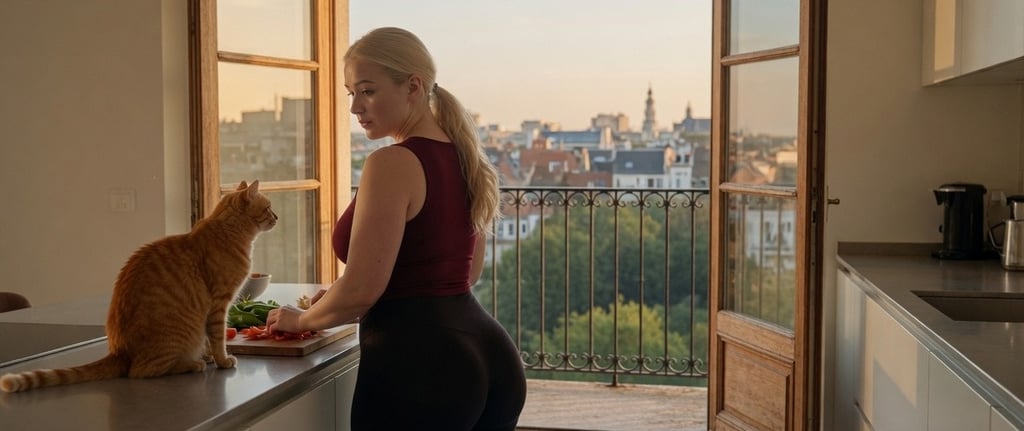

Frida's Tears
Frida
Soo-ah finishes her ponytail in front of the mirror. She meets Frida's eyes in the reflection.
— Frida… I'm listening. You already know what I'm going to say. But tell me anyway, exactly what you want.
— Am I really that predictable? I love you, Soo-ah. I've been seeing you for two years, I've been with you. You're the woman of my life. I can't pretend this doesn't exist.
Soo-ah turns on the chair to face Frida.
— You're not predictable. But we've talked about this before, more than once. I know you. I know what you feel.
She looks at her without blinking.
— I love you too. Really. These two years with you have been beautiful, precious. You make me laugh, you do me good. But you've known from the start… Gian comes first. Always. That won't change. It's just who I am.
Her hand brushes Frida's cheek softly.
— What do you want, exactly?
— I don't understand. What do you mean, he comes first? You've never really explained what he is to you. The moment he needs you, it's as if I don't exist anymore.
Soo-ah stands up, takes Frida's face in her hands, wipes her tears.
— Don't cry. It hurts me to see you like this.
She presses her forehead against hers, then steps back to look at her.
— Gian Piero is my Oppa. He saved me when I was sixteen. He gave me everything — a life, an education, a security I would never have had. But it's not only a debt. I am his Nae saram. I belong to him, entirely. And that will never change.
Her voice is firm, gentle, without anger.
— You matter to me, Frida. And if you decide that the two of us isn't possible anymore, I'll be sad… But he comes first. Always. Because I can't be otherwise.
— I can't picture you in his arms. Thinking that he enters you, that he puts his hands and his mouth on you — I can't accept it.
— I know. I see how much it hurts you.
Soo-ah caresses Frida's cheeks slowly, wipes her tears.
— Yes. He enters me when he wants to, if he wants to. It doesn't happen often, and it doesn't matter much to him — he loves me, but I'm not the woman he's looking for. And when he finds her, that won't change anything. I can't promise you it won't happen again. But you're part of me too. In another way.
She places a very light kiss on Frida's forehead, then looks at her.
— Can you live with that? Or is it going to destroy you, little by little?
— Will it always be like this? He might die one day.
— No. Even then, this bond won't disappear. It's part of who I am.
Something passes in her voice, almost imperceptible.
— I want to keep seeing you. But only if you can accept what I am. Can you? Or is it going to end up breaking you?
Frida doesn't answer right away. Her tears fall in silence.
— I have so much sorrow. I'm in despair. I don't want to lose you.
She cries, her eyes shining.
Soo-ah pulls her against her, feels Frida's tears against her neck. She lifts her face and kisses her slowly, long. Then murmurs against her mouth.
— Come.
She takes her by the hand to the futon, kneels in front of her, unbuttons her blouse, her fingers brushing her skin. Her eyes in hers.
— Just the two of us. Tell me what you need.
Her hands glide over Frida's body, caressing her breasts, her waist, her hips. She kisses her on the neck, descends slowly.
She slides the blouse off Frida's shoulders. Frida closes her eyes the way one surrenders. Soo-ah smiles — she knows her so well.
She leans down, and her lips find a nipple, tug at it gently. Frida breathes faster. The ponytail slides over her shoulder, and she shivers — Soo-ah knows these things, what makes her tremble, what makes her melt.
— I want you so much. I've never felt this with another woman. Help me take off my shorts.
Soo-ah brings her mouth close to hers without quite kissing her. Her hands slide down to her waist, slip the shorts along her hips, her thighs that she loves so much. She takes her time. With Frida she always takes her time.
— You're the first woman who hasn't asked me to shave. When your mouth makes me come, I want to scream.
— You're beautiful like this. I don't see why you would shave.
It's not politeness. Soo-ah loves this woman exactly as she is — her Nordic skin, her hair, the way she weeps when they make love.
She removes the underwear. Settles in. Her mouth finds what it's looking for and lingers there, slow and precise. Frida moans. Soo-ah listens — she recognizes that moan, the one that means Frida is going to let herself go for a long time. Her fingers enter her gently.
— Scream if you want to. I want to hear you.
— Soo-ah… you drive me crazy. When can we go away together, just a few days?
Soo-ah lifts her head. Frida is entirely hers, here, now — and that's the moment she chooses to ask. Soo-ah understands why.
— I would love that. Just the two of us.
A second of silence.
— But we have to find a time when Gian Piero doesn't need me. I'll ask him tonight.
Frida closes her eyes. Soo-ah doesn't apologize. She caresses her body, kisses her deeply, her thigh slipped between hers to bring Frida back here, into this room, into what is happening.
— Let yourself go.
She comes back down. Her mouth resumes, more present, more tender still… and Frida moans.
The Next Day
The café is small, near Place Flagey. Frida arrived first, she chose a table at the back, her back to the wall. When Soo-ah comes in, she barely looks up. Soo-ah sits down across from her, takes off her scarf, orders a tea without looking at the menu.
Frida doesn't know how to begin. She rehearsed three sentences on the tram and none of them hold up now that she has Soo-ah in front of her, calm, attentive, exactly the same as last night.
— I wanted to ask you…
Her voice breaks, she starts again.
— Would you come and sleep at my place tonight?
She lowers her eyes to her cup.
— I don't know if you still want me.
Soo-ah places her hand over Frida's on the table. She doesn't say anything right away. She waits for Frida to look up.
— Frida.
Frida looks up.
— Of course I'll come.
Frida looks at Soo-ah's hand on hers. She wants to cry again, but not for the same reasons. She catches her breath. Soo-ah doesn't take her hand back.
— Yesterday I thought you were going to tell me it was over. All night I thought about that, even when we… even after. I couldn't get it out of my head.
— It's not over, Frida.
Soo-ah says it simply, the way you tell someone the time.
— I spoke with Gian Piero this morning. I have things to tell you.
Frida straightens up a little. She doesn't know if it's good or bad. With Soo-ah she never knows in advance.
— What?
— First — he doesn't need me next weekend. We can go away for three days. The coast, if you want. He has an apartment in La Panne.
Frida opens her mouth, closes it.
— Three days.
— Three days.
— Both of us.
— Just the two of us.
Frida looks out the window. It's grey outside, you can feel the cold. She thinks about the wind on the beach, the waffles, sleeping with Soo-ah three nights in a row. She also thinks that it was Gian who said yes. He's the one who allowed it. But she doesn't say anything about that.
— And the other thing?
Soo-ah hesitates barely.
— I'll tell you tonight. Not here.
That evening
Soo-ah locks her bicycle to the railing downstairs and looks up at the façade. The fifth floor is lit. She walks up — she never takes the elevator when she can avoid it.
Frida opens the door before she rings. She's barefoot, wearing cream corduroy trousers that fall loose at the ankles, an oversized cashmere sweater sliding off one shoulder. Her blond hair is still damp.
— Your cheeks are red.
— It's cold out.
— I hope you haven't eaten.
Soo-ah smiles. That's exactly the kind of sentence she likes to hear.
— No.
She comes in. Takes off her down jacket, her scarf, her boots. Lets her bun down — her dark hair falls to her shoulders. Underneath, a fine slate-grey wool crew-neck sweater, a tank top you can guess at when she raises her arms. She's slim, an elegant silhouette, where Frida is a Renoir model.
The apartment smells of lemon and dill. Behind the large bay window, the parc de Forest slips down into the grey. On the coffee table, Frida has set two plates, smoked salmon, warm potatoes, cream, lemon. Two glasses. A bottle of white wine in a bucket. A candle.
Soo-ah looks at it all for a moment without saying anything.
— Det er vakkert, Frida murmurs. It's beautiful.
Then, in French, slowly:
— Je t'ai fait à manger. (I made you something to eat.)
She stumbles over manger, laughs to herself.
— I'm learning. French is very difficult.
Soo-ah sits down on the rug in front of the coffee table. She looks at home.
— You're learning well.
— Liar.
Frida pours her a glass of wine and sits across from her, legs folded under her. Outside, night falls over the park. They eat for a while without speaking. Frida asks a question about Soo-ah's day, Soo-ah answers briefly. The salmon is good. Frida relaxes, a little.
Then she sets down her glass.
— This morning you told me there was something else. To tell me.
Soo-ah looks at her. Sets down her glass too.
— Yes.
The Proposal
They clear the table together without a word. Frida rinses the plates, Soo-ah dries them. When everything is done, Frida turns off the kitchen light, brings the wine bottle back to the coffee table and settles on the futon. She pats the spot next to her.
— Come here.
Soo-ah lies down, rests her neck on Frida's thighs. Frida pulls a blanket over them both. Her hand passes gently through Soo-ah's hair. Frida's breasts, under the cashmere sweater, brush Soo-ah's forehead when she leans forward to grab the remote.
— Arte?
— Sure.
It's a documentary about Flemish painters of the fifteenth century. Frida loses the thread after ten minutes. Soo-ah is still watching, in moments, but she closes her eyes too. They don't talk. Outside the rain has started, fine, against the bay window. The park has disappeared into the night. There's only the candlelight on the coffee table and the screen changing colour with each painting.
Frida strokes Soo-ah's hair. After a while she whispers:
— I feel good.
Soo-ah opens her eyes. She catches Frida's hand resting on her chest, kisses the hollow of her palm.
— Me too.
The silence comes back. The documentary goes on. Somewhere near the end, Frida feels that Soo-ah is breathing differently. She knows. It's coming.
Soo-ah sits up gently, settles facing her on the futon, legs crossed. She takes the remote, mutes the sound.
— Frida.
— Yes.
— Last night, after - when we made love - I thought a lot about you. About us. About what I can give you and what I can't.
Frida says nothing. She waits.
— I know you don't understand Gian Piero. I know it hurts you not to understand him. And I know it's not going to get better just because I tell you with words.
— No.
— So I thought about something else.
Soo-ah picks up Frida's glass of wine from the coffee table, takes a sip, sets it down. She doesn't need courage. She just wants to choose the moment.
— I would like you to come over one evening. For us to make love in front of him.
Frida goes still for a second. Picks up her glass, puts it down without drinking.
— Excuse me?
— You heard me.
— Soo-ah. No.
She says no but she doesn't move. She looks at Soo-ah, and Soo-ah can already see the second wave coming behind the no.
— Are you serious?
— Yes.
— You want us to make love in front of him? Just like that, one evening we come over, we take off our sweaters, and he's going to watch us. No, but Soo-ah.
Soo-ah doesn't smile. She lets Frida pass through her own indignation. It's necessary.
— I know you, Frida. I know you're at ease in your body. I know you're not afraid to be looked at.
— That's not the point.
— Yes, it is. Part of it.
Frida stands up. Goes to the window. Stays there, her back to Soo-ah, arms crossed. She looks at the rain over the park.
Soo-ah doesn't get up. She stays on the futon, the blanket over her legs.
— You can say no, Frida. This isn't something you have to answer right now.
— Why are you asking me this?
— Because I love you. Because I want you to have a place that exists for him too.
Frida turns around. Her eyes are shining again, but it's not the same as last night.
— So now I have to make love with you in front of a man I don't know in order to have a place? Is that what you're telling me?
— No.
Soo-ah lets the word sit for a second.
— You have a place with me, Frida. You've had it for two years. But with him you have none. And as long as you don't, you'll keep seeing him as a wall. As something that takes from you what is yours.
— That's what he does.
— No. That's what you think he does.
Frida doesn't answer right away. She comes back toward the futon, but doesn't sit down. She stays standing in front of Soo-ah.
— And him, what does he think about it?
— We've talked about it. Not about your answer yet — that's what I had to bring to you first.
Something in Soo-ah's tone stops Frida for a second. Not a displayed certainty. Just a calm that comes from further away — as if for Soo-ah and Gian Piero, what she has just proposed belonged to a register already known. Frida doesn't know what they have lived through together. She just knows that at this instant, she vaguely senses it, and that she is the only one who doesn't.
— Your answer is what matters.
— My answer.
— Yes.
Frida sits back down on the futon, but at a distance. She pulls her knees against her chest.
Soo-ah looks at her. Frida curled up like that, the sweater slipping off her shoulder, her hair falling forward — Soo-ah finds her beautiful. Beautiful because round, because sensitive, because she doesn't know how to lie with her body. Beautiful also in her wound.
— I don't want you to keep tearing yourself up. What I'm asking you is whether you can do it.
Frida doesn't answer right away. She rests her forehead on her knees. Soo-ah doesn't move. She has learned to wait.
— I don't know, Soo-ah.
— I know you don't know.
— How would it work? I mean — concretely. We arrive, we undress, he's sitting in an armchair, we…
— You come to the apartment. I introduce you to Gian Piero. We have a glass of wine. We talk a little if you want. And then we go to my room. He watches us.
— And what is he going to do?
— I don't know. What is certain is that he won't do anything you don't want, nothing that would make you uncomfortable.
Frida pulls the blanket over her legs. The silence comes back. The rain is still falling on the bay window. The candle has burned down by half.
— And him, what does he get out of it?
Soo-ah takes her time to answer.
— I think he likes it when the people I care about exist for him too. That's all.
Frida says nothing. She holds her hand out to Soo-ah. Soo-ah takes it. They stay like that.
Frida doesn't let go of Soo-ah's hand. She says nothing. Soo-ah looks at her, and she sees something pass over Frida's face — not exactly a reflection. Frida doesn't think like that. Frida senses. And what she senses now is that someone is holding something out to her that could heal.
Soo-ah doesn't press. She waits. She has learned to wait for important things — it may even be all she has done for eight years.
Frida looks at the bay window. Then at Soo-ah. Then at the bay window. The candle crackles for a second. Frida pulls her hair to one side of her neck, the gesture she makes when something is setting into place inside her.
— All right.
Soo-ah doesn't say anything right away.
— Are you sure.
— Yes.
— Whenever you want.
— Soon. I don't want to think about it too long. I know if I wait I'll be afraid.
— Good.
Frida sits up. She pulls the sweater off over her head without ceremony. The cream cashmere falls onto the rug.
She's wearing nothing underneath. Her breasts are there, heavy, firm, white in the candlelight. Soo-ah has seen them often and it's always the same — a blow to the stomach, a low heat, the feeling that her own skin has forgotten to breathe for a second. Frida knows it, from the start.
— Will you come to bed with me? Frida says. I want to feel you against me.
The text
Later, Frida is asleep on her stomach, one arm draped across Soo-ah's belly, her cheek against her shoulder. The lamp is off. Only the bay window lets in the light from the streetlamps below.
Soo-ah gently reaches toward the bedside table, picks up her phone. The screen dazzles her for a second, the letters standing out in a bluish tint. Three small dots. Gian. She types.
You were right. She'll do it. Thank you. See you tomorrow.
She sends. Sets the phone face down on the bedside table. Closes her eyes. Frida's hand on her belly is warm.
Outside the night is cold. The end of winter still holds Brussels in its fist. Above the parc de Forest, a tawny owl passes, drawn perhaps by the light of a window still lit further on. It glides along the fifth-floor façade, lingers on the balcony that adjoins the bay window — two young women in love, dark hair, blond hair, their bodies fitted together under a white duvet.
Then it continues toward Saint-Gilles. The city sleeps.